Every spring, parents ask us some version of the same question. The wording shifts, but the worry behind it is identical: "Is my child going to be ready for kindergarten?" Behind the question, you can sometimes hear an undertone — am I doing enough? Should we be drilling sight words at home? Should I buy that workbook? Have I let my child be too playful for too long?
We want to address this directly, because the panic is real and the answer is genuinely reassuring once you look at what kindergarten readiness actually means.
What kindergartens actually screen for
If you read California's official kindergarten readiness framework, or the National Association for the Education of Young Children's (NAEYC) widely cited position statements on developmentally appropriate practice, the indicators are mostly not what parents expect. They are not "knows all 26 letters" and "can count to 100." Those skills appear, but they are far from the top of the list.
The strongest predictors of kindergarten success, across the developmental literature, are clusters of social-emotional and self-regulation skills: can the child wait their turn, follow a two-step direction, separate from a parent without distress, regulate big feelings without hitting, sustain attention on a task for ten minutes, ask for help, take care of their own bathroom needs, and engage with peers cooperatively?
A child who can do those things will pick up letters and numbers in kindergarten in a matter of weeks. A child who cannot do those things — but who has been drilled on phonics — will struggle the entire year, regardless of what they technically know.
The skills we actually cultivate
Here are the skills our preschool day is designed to develop, all of which are kindergarten readiness skills, none of which appear on a flashcard.
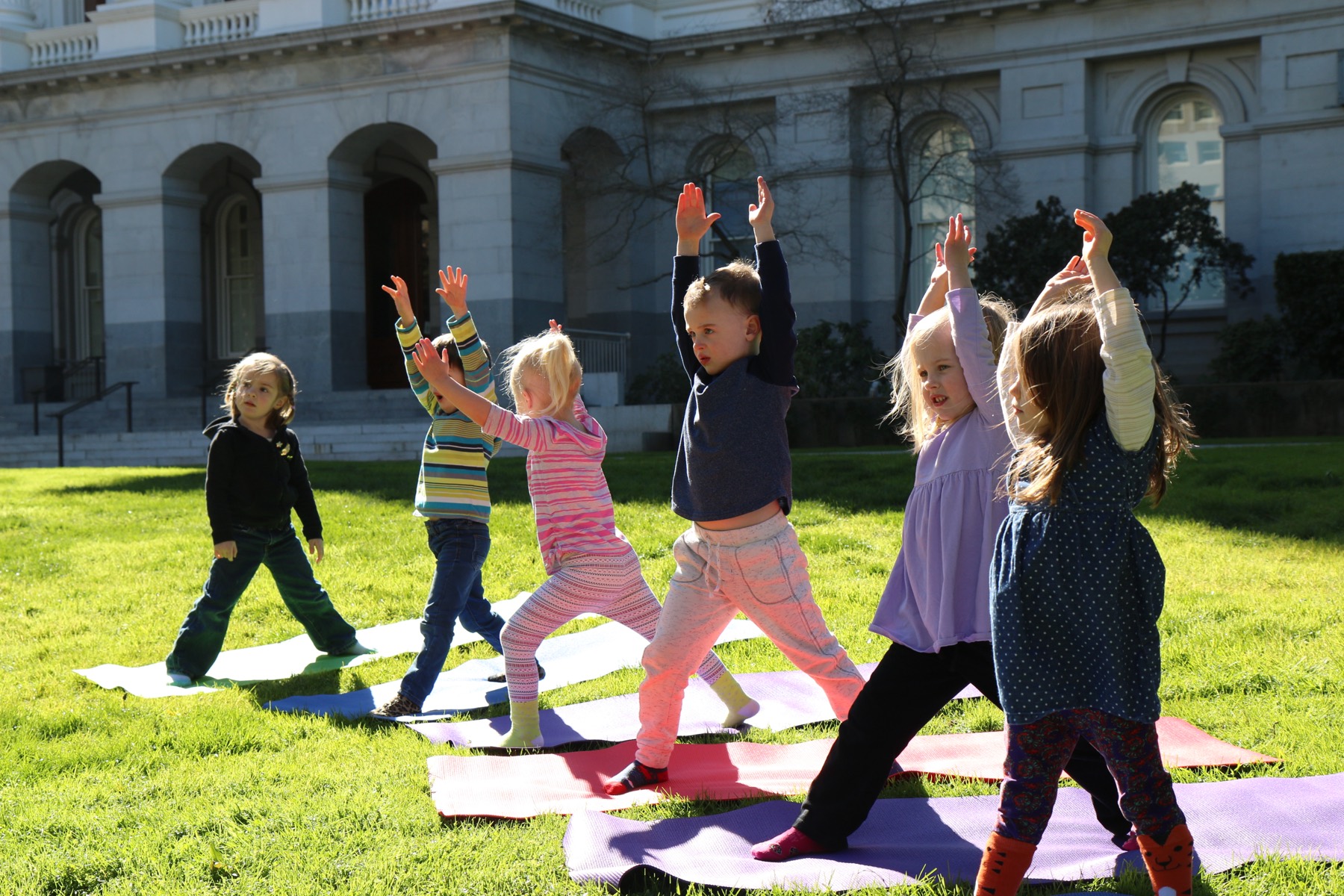
Self-regulation. Practiced every day in mindfulness moments — naming feelings, taking three breaths, using a calm corner instead of hitting. By age five, our children typically have the vocabulary to say "I'm frustrated" before the meltdown, not after.
Sustained attention. Built through long, choice-based play blocks rather than fragmented adult-led activities. A child who has spent an hour deep in a building project has practiced focus more meaningfully than one who has done six worksheets in the same time.
Following multi-step directions. Practiced through routines (hand washing, lining up, transitions) and through small-group activities where the teacher gives a sequence and steps back.
Cooperative play and conflict resolution. Built through long stretches of unstructured time with peers, supported by teachers who coach rather than referee. Children practice negotiation, perspective-taking, and repair after a disagreement.
Independence and self-care. Children put on their own coats, manage their own belongings, serve themselves at family-style meals, and take care of bathroom needs. We don't do for the child what the child can do.
Pre-literacy and pre-numeracy. Letter recognition, phonemic awareness, counting, sorting, patterning — these are woven through the day in the small-group block and through emergent projects. Children learn them in context (writing labels for their shadow project, counting how many friends are at the table) rather than in isolation.
Curiosity and the habit of wondering. This is the one most schools forget to name as a kindergarten readiness skill, but it predicts academic engagement for years. A child who has been encouraged to ask questions and pursue them — the central practice of our Reggio-inspired approach — walks into kindergarten ready to be a learner, not a recipient.
A quiet piece of evidence
We don't run formal longitudinal studies on our alumni — we are a small school. But we do hear from families.
One mother wrote to us recently from a school assembly. Her daughter had attended Growing Mindfully and was now in first grade. Of the four children in her daughter's class receiving the school's "scholar award" that morning, all four had come over from Growing Mindfully. She thought we should know.
We mention this not to brag, and not to suggest that play-based preschool guarantees academic awards in elementary school. It doesn't. Many factors shape how a child does in school. But the story is consistent with what the research suggests: children who arrive at kindergarten with strong self-regulation, sustained attention, social skills, and curiosity tend to thrive academically once they get there. The "academic" stuff comes faster when the foundation is solid.
You can read more from our families in the testimonials section of our homepage.
What about the worksheets at other schools?
Here is where we want to push back gently, without being defensive.
Worksheet-based preschool has not been shown, in long-term studies, to produce better kindergarten outcomes — and in some studies, the children pushed academically before they were developmentally ready showed worse outcomes by third or fourth grade than play-based peers. The HighScope Perry Preschool studies and several of the longitudinal studies referenced by the U.S. Department of Education's What Works Clearinghouse point in this direction.
Why? A few reasons. Children pushed too early often develop a negative relationship with academics. They learn that school feels like a test. They miss the developmental window for the play-based learning that builds executive function. And the early "lead" they appeared to have in pre-K disappears by second grade, when the play-based children catch up — usually faster, with more enthusiasm intact.
This is not an argument against rigor. It is an argument for developmentally appropriate rigor. Long blocks of choice-based play are rigorous. Building a working pulley system out of cardboard and string is rigorous. So is mediating a disagreement with a friend over who gets the red bin. We are not making things easier for children. We are matching the work to the developmental moment.
What we believe at Growing Mindfully
We believe a kindergarten-ready child is a child who knows how to learn. A child who can sit with frustration and try again. A child who can name what they are feeling. A child who can take care of themselves and their things. A child who is genuinely curious about the world and trusts that her questions are welcome.
We will continue to build the academic skills — letters, numbers, pre-reading, early math — in age-appropriate ways. But we will not sacrifice the foundation to do so. The foundation is the readiness.
If you'd like to see how this plays out in the daily schedule, our hour-by-hour day shows where the academic blocks sit alongside the choice-based and mindfulness blocks. Or to talk with us about your child's specific kindergarten timeline, reach out through our enrollment process.