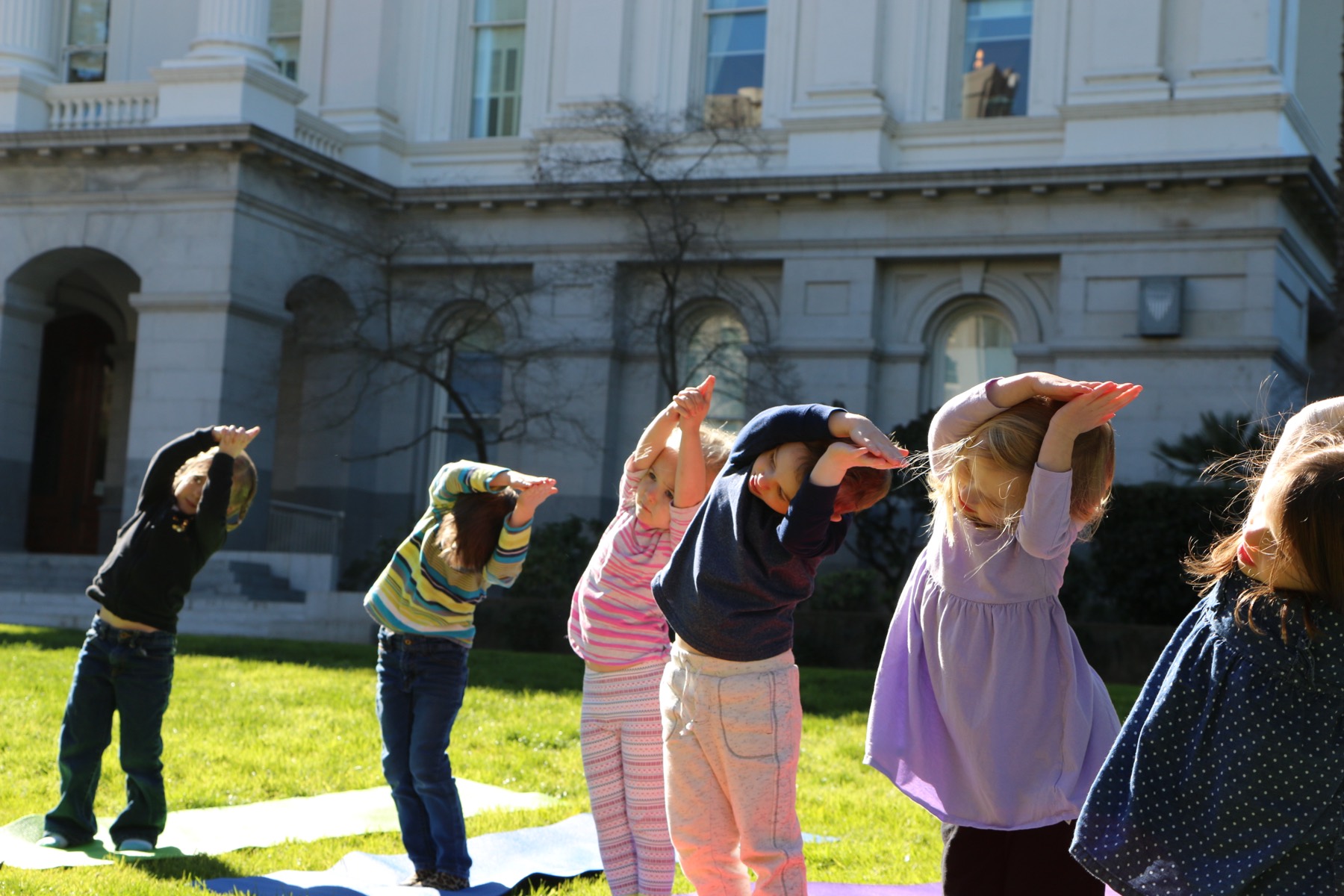
A parent asked me last week, with real worry in her voice, whether her three-year-old could really sit still long enough to meditate. She'd seen the photos on our website — children cross-legged on yoga mats — and was bracing for her own son to be the one squirming, refusing, ruining the picture. I told her the truth: he probably will squirm. And he is still doing the practice.
That's the thing about mindfulness with a child this age. It looks almost nothing like what adults imagine. It is not silent. It is rarely still. And it is happening all day long, in moments most adults wouldn't even notice.
What mindfulness is, when the practitioner is three
Jon Kabat-Zinn, who introduced mindfulness into mainstream Western medicine through his work at UMass, defines the practice as "paying attention on purpose, in the present moment, non-judgmentally." That definition is the same whether you are forty-five and on a meditation cushion or three and standing in front of a butterfly.
What changes is the form. A three-year-old's attention span is roughly six to ten minutes for a focused activity. Their nervous system is still building the wiring for self-regulation — the prefrontal cortex won't fully myelinate until their mid-twenties. So we don't ask them to meditate the way an adult does. We give them tiny, embodied entry points to the same skill: noticing what's here, on purpose, without labeling it as good or bad.
In practice, this looks like three breaths before a transition. Naming the color of the leaf you just picked up. Putting a hand on your belly to feel it rise. Saying "my body feels jumpy" instead of hitting your friend. None of these are fancy. All of them are mindfulness.
The four moves we teach, again and again
Almost everything we do with three-year-olds builds one of four micro-skills. We name them out loud so children develop the vocabulary alongside the practice.
Notice. Eyes on the spider on the wall. Ears on the truck outside. Hand on the cool drinking fountain. We point to what's already happening in the room and ask children to direct their attention toward it for ten seconds.
Breathe. Three slow breaths, often with a hand on the chest or the belly. We use props sometimes — a hoberman sphere that opens and closes, a feather to keep aloft, a candle (battery-powered) to "blow out" gently. The goal is for the child to feel the connection between breath and the soft settling of the body.
Name. This is Daniel Siegel's "name it to tame it." When a child can put words to what's happening inside them — "I am angry," "I feel left out," "my legs want to run" — the prefrontal cortex begins regulating the limbic flare. We coach this constantly: "Looks like big feelings. Can you tell me?"
Pause. The hardest one. Before reacting, take one breath. We practice this in low-stakes moments (before opening a snack, before getting in line) so it becomes available in high-stakes ones.
Where it actually shows up in the day
In a Mindful Monday morning circle, a teacher rings a small bell and asks the children to listen until they can no longer hear it. Most three-year-olds last about eight seconds. That's the practice.
Before lunch, one of our preschool teachers does a "three-bite check-in." Take three bites of your food. Then notice — is your body still hungry, or comfortable? It sounds simple, but it's interoception, the sense of internal state, and it's one of the most underdeveloped capacities in modern children.
When a child crashes a friend's block tower in frustration, the teacher kneels to eye level and says, "I see your body feels frustrated. The tower fell. Let's take three breaths together, and then we'll figure out what to do." She doesn't bypass the consequence. She doesn't shame the child. She practices the move in the moment it's needed.
What changes after a few months
We don't promise a calmer child. We don't promise fewer tantrums. Every three-year-old has a developing brain that will, on schedule, lose its lid sometimes.
What we do see — and what parents tell us they see at home — is that children begin to recognize their own states earlier in the cycle. A child who used to escalate from zero to meltdown in fifteen seconds starts to say, four months in, "I need a break." A child who used to bite when overwhelmed starts to walk to the calm corner on her own. One mom told us her daughter now reminds her, the parent, to take three breaths when she's getting upset in traffic.
That's the real outcome. Not a Zen child. A child who has the early scaffolding to notice, name, breathe, and pause — skills that, according to research summarized by organizations like Mindful Schools, predict better attention, better peer relationships, and better academic engagement years later.
What we believe at Growing Mindfully
We started teaching mindfulness from six weeks of age, not three, because the foundation of self-regulation is laid in infancy through responsive caregiving. By three, a child who has been seen, paused with, and named for since babyhood has a head start. We don't think of mindfulness as a curriculum bolted on top of preschool. We think of it as the way we move through every transition, every conflict, every snack — a hundred small invitations a day.
Our pillars — present, playful, rooted — are not three separate things. Mindfulness is what makes a child present enough to be truly playful and ultimately rooted in themselves.
If you want to see what this looks like in a real day, the hour-by-hour breakdown of our schedule on the homepage shows where mindfulness sits inside the rhythm. Or come meet the educators who do this work.